
ROBOTICS
Description
Industrial Robotics and Automation Solutions by Dhyan Automation Machinery Pvt. Ltd.
Dhyan Automation Machinery Pvt. Ltd., based in Ahmedabad, Gujarat, India, offers industrial machinery and automation solutions designed to support modern manufacturing and production requirements. Industrial robotics can help businesses automate repetitive tasks, improve operational consistency, optimize material handling, and streamline production workflows.
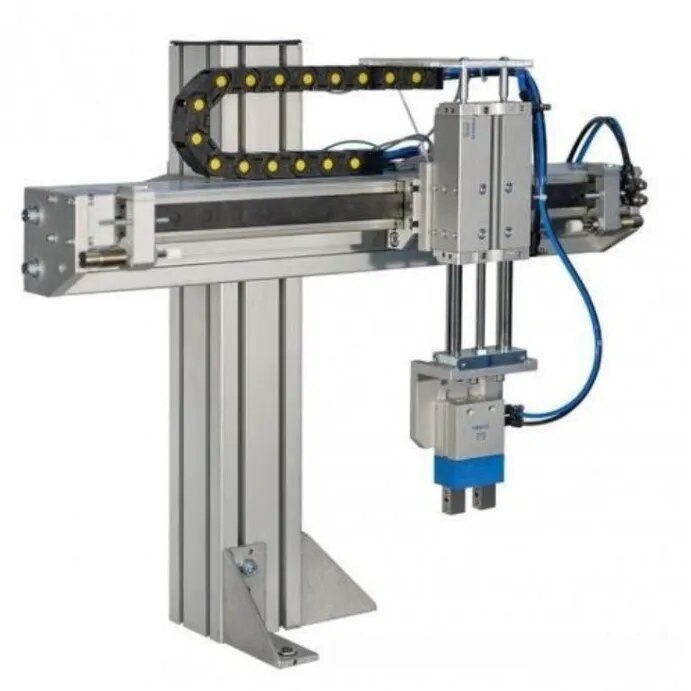
Robotic automation is increasingly used in industrial environments to perform tasks such as product handling, pick-and-place operations, machine tending, assembly assistance, packaging, palletizing, and material transfer. The appropriate robotic system depends on the application, payload requirements, operating speed, working range, production environment, and integration needs.
Implementing suitable robotic automation can help manufacturers reduce repetitive manual work, improve process repeatability, and create more organized production workflows. Depending on the system configuration, robotics can also support integration with conveyors, packaging machinery, sensors, vision systems, and other compatible industrial equipment.
Dhyan Automation Machinery Pvt. Ltd. supports industrial automation requirements with solutions that should be selected according to each customer's operational objectives. The exact robot type, functions, technical specifications, and integration capabilities must be confirmed for the required application.
## Key Features
- Designed to support industrial automation requirements.
- Can automate repetitive and predefined production tasks.
- Supports consistent task execution when correctly programmed and configured.
- Potential applications in material handling and product transfer.
- May support pick-and-place and machine-tending operations, depending on the robot type.
- Can be integrated with compatible production equipment.
- Supports flexible automation planning for different industrial workflows.
- Safety systems and control features depend on the selected robotic solution.
## Technical Specifications
The supplied product page does not provide enough verified information to identify a specific robot model or confirm its technical specifications. The following parameters should be finalized with the manufacturer.
| Specification | Details |
|---|---|
| Product category | Industrial Robotics and Automation |
| Manufacturer | Dhyan Automation Machinery Pvt. Ltd. |
| Location | Ahmedabad, Gujarat, India |
| Robot type | To be confirmed |
| Number of axes | Model-specific |
| Payload capacity | To be confirmed |
| Working reach | To be confirmed |
| Operating speed | Model-specific |
| Positioning repeatability | To be confirmed |
| Control system | Model-specific |
| Programming interface | To be confirmed |
| End-of-arm tooling | Application-specific |
| Integration capability | Subject to compatibility |
| Power requirements | To be confirmed |
| Safety system | Based on the selected design and applicable standards |
| Customization | Subject to technical feasibility |
## Applications of Industrial Robotics
Depending on the selected robotic system, industrial robotics may be used for:
- Pick-and-place operations
- Material handling and product transfer
- Machine tending
- Assembly assistance
- Packaging and product loading
- Palletizing and depalletizing
- Repetitive production tasks
- Integration with conveyors and automated production lines
- Handling applications requiring consistent positioning
These are general industrial robotics applications and are not a confirmation that every function is available on the specific product listed on the website.
## Benefits of Industrial Robotics
### Improved Productivity
Robotic automation can help perform suitable repetitive tasks efficiently and support continuous production workflows when the system is designed for the required operating cycle.
### Consistent Operations
A correctly programmed robot can repeat defined movements and tasks, helping maintain process consistency.
### Reduced Repetitive Manual Work
Automation can reduce the need for workers to perform repetitive handling tasks, allowing staff to focus on supervision, quality checks, and other activities.
### Improved Material Handling
Suitable robots can transfer products between designated stations and support better coordination across production processes.
### Flexible Production Workflows
Depending on the robot design and tooling, a system may be reprogrammed or reconfigured for different tasks within its capabilities.
### Integration with Automation Equipment
Compatible robots can be connected with conveyors, sensors, machine controls, and other equipment to support coordinated production operations.
## How Industrial Robotics Works
The operating process depends on the robot type and application. A typical industrial robotic system works through the following stages:
1. Task definition: The required operation, product dimensions, payload, and cycle requirements are identified.
2. System configuration: The robot, tooling, controller, sensors, and safety equipment are selected for the application.
3. Programming: The robot is programmed to follow the required movement sequence and operating logic.
4. Product interaction: The robot uses suitable tooling to grip, move, position, or process the product.
5. Process coordination: The robotic system communicates with compatible machinery or sensors where required.
6. Monitoring and maintenance: Operators monitor system performance and follow the prescribed inspection and maintenance procedures.
Robotic equipment must be installed, programmed, and commissioned by qualified personnel. Appropriate guarding, risk assessment, and safety controls are essential before production use.
## Factors to Consider When Selecting a Robotic System
Before investing in industrial robotics, evaluate the following:
- Intended task and production objective
- Product weight, dimensions, and material characteristics
- Required payload and working reach
- Required cycle time and operating speed
- Positioning accuracy and repeatability requirements
- Type of gripper or end-of-arm tooling
- Available installation space and robot mounting arrangement
- Compatibility with existing machinery and control systems
- Safety requirements and operator access
- Programming, training, maintenance, and technical support
- Expected production growth and future automation needs
## Why Choose Dhyan Automation Machinery Pvt. Ltd.?
Dhyan Automation Machinery Pvt. Ltd. is based in Ahmedabad, Gujarat, India, and serves industrial machinery and automation requirements. Selecting the right robotic solution begins with understanding the production task, required performance, available space, and integration requirements.
Before finalizing a robotic system, businesses should confirm the robot model, payload, working reach, cycle performance, controller, tooling, safety provisions, and compatibility with existing equipment. Proper system design and commissioning are important for achieving reliable operation and meeting production objectives.
## Frequently Asked Questions
1. What is industrial robotics?
Industrial robotics involves using programmable robotic systems to perform manufacturing, handling, assembly, packaging, and other industrial tasks.
2. What tasks can industrial robots perform?
Depending on the robot type and configuration, industrial robots can perform pick-and-place, material handling, machine tending, assembly assistance, packaging, and palletizing.
3. Can industrial robotics improve productivity?
Yes. When properly selected and integrated, robotic systems can reduce repetitive manual tasks, improve process consistency, and support efficient production workflows.
4. Can a robotic system be integrated with existing machinery?
Integration may be possible when the robot, controls, interfaces, workspace, and safety systems are compatible with the existing equipment.
5. Can robots handle different product sizes?
This depends on the robot's payload, reach, tooling, programming, and application design. Product changes may require different grippers or configuration adjustments.
6. What specifications should be checked before purchasing a robot?
Important specifications include payload, reach, number of axes, cycle time, positioning repeatability, controller, tooling, power requirements, and safety provisions.
7. Is operator training required?
Yes. Personnel responsible for operating, programming, maintaining, or supervising robotic equipment should receive appropriate training for the installed system.
8. Where is Dhyan Automation Machinery Pvt. Ltd. located?
Dhyan Automation Machinery Pvt. Ltd. is based in Ahmedabad, Gujarat, India.
Dhyan Automation Machinery Pvt. Ltd., Ahmedabad, Gujarat, India, provides industrial machinery and automation solutions for manufacturing requirements. Industrial robotics can help automate repetitive tasks, support material handling, improve process consistency, and streamline production workflows. The appropriate robotic system depends on the application, payload, working reach, cycle requirements, and integration needs. Contact the manufacturer to confirm available robotic solutions and technical specifications.
Industrial Robotics and Automation Solutions in Ahmedabad | Dhyan Automation
Explore industrial robotics and automation solutions from Dhyan Automation Machinery Pvt. Ltd., Ahmedabad, Gujarat. Confirm suitable robotic systems for your production requirements.
- Industrial Robotics in Ahmedabad
- Industrial Robotics Solutions
- Industrial Automation Solutions in Gujarat
- Robotic Automation Systems
- Industrial Robot Supplier in India
- Manufacturing Automation Solutions
- Industrial Material Handling Automation
- Robotic Packaging Automation
- Industrial Robotics and Machinery
- Automation Solutions Manufacturer in Ahmedabad
## Product USP
Application-focused industrial robotics and automation solutions designed to support repetitive-task automation, consistent operations, and efficient manufacturing workflows, subject to the selected system's capabilities.